

Walking,
measured as exercise.
Caminar con ciencia is not a walking stopwatch. It estimates your exercise dose — how long, how hard, how often — and shows whether your capacity is improving. Built on clinical exercise science, designed for people living with known cardiovascular disease.
Prototype: this form is simulated and does not store or send anything.
Thank you! You’re on the list (simulated).
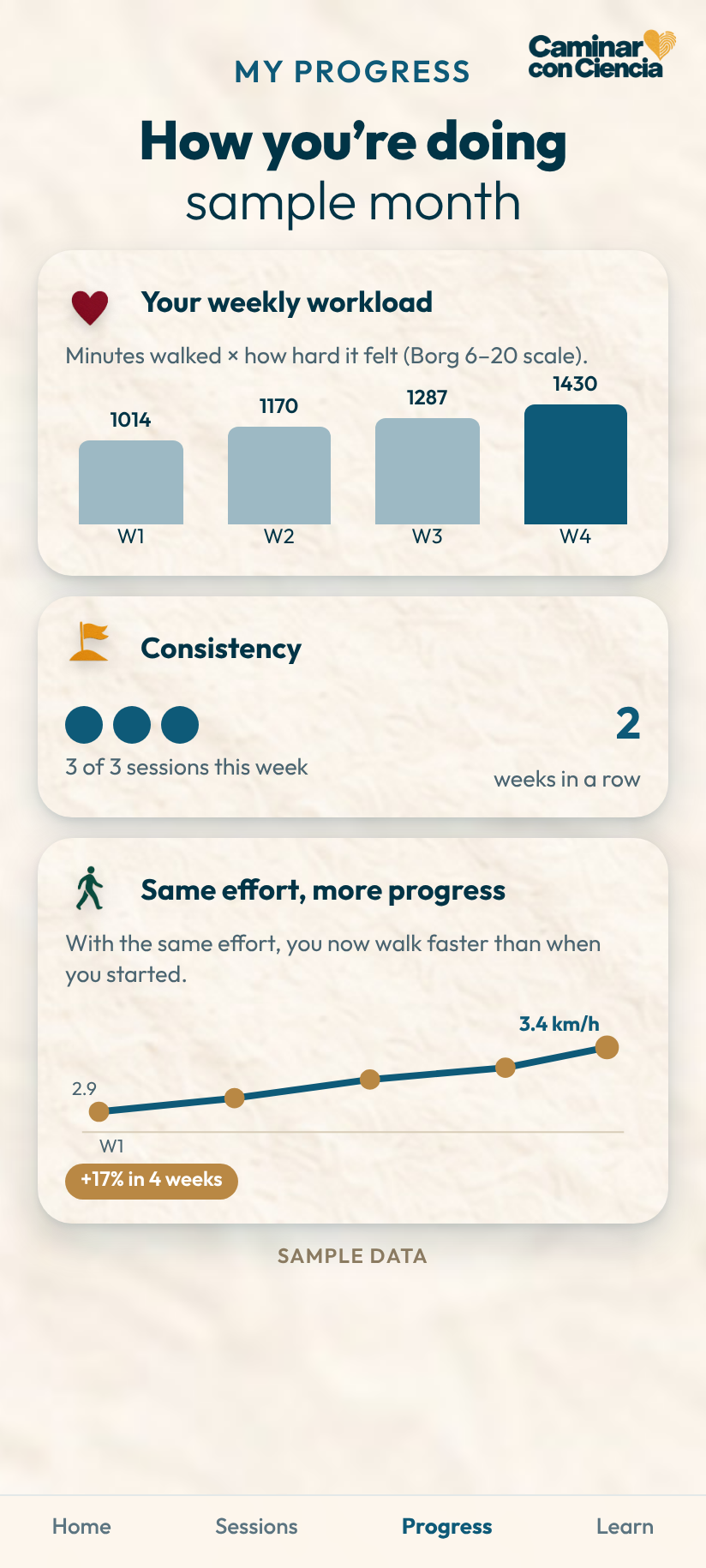
Not a stopwatch. A dose meter.
Most walking apps count steps, minutes and kilometers. Clinical exercise guidelines prescribe something else: minutes, intensity and weekly frequency. Caminar con ciencia measures what the guidelines actually prescribe.
A walking stopwatch
- Counts steps or minutes
- Every walk looks the same
- Ignores hills, stairs and how you felt
- Speed is the only “progress”
Caminar con ciencia
- Session load = minutes × perceived effort (Borg)
- Weekly load and its trend
- Extra effort from hills, via the phone’s barometer
- Progress = walking faster at the same effort

Session load
Minutes × Borg 6–20, inspired by Foster’s session-RPE (which uses CR-10): one number for volume and intensity.
minutes × Borg (6–20)
Weekly load & trend
Sum of the week’s sessions and its change vs. last week.
Σ week · % change
METs with grade
ACSM walking equation, including the uphill component.
VO₂ = 3.5 + 0.1·S + 1.8·S·G
Consistency
Sessions done vs. planned, and weeks in a row.
done ÷ planned
Same effort, more speed
Speed at the same Borg rating, week after week.
km/h at equal RPE
Borg ↔ talk test
Does perceived effort agree with being able to talk?
matches ÷ sessions
Morning status ↔ walk
How you woke up vs. how you walked that day.
speed by check-in
Heart-rate zone
Time in your zone — only with a watch or strap.
% time in zoneAll indicators are estimates to guide walking and follow-up, not diagnoses. They do not replace evaluation by a cardiologist or the professional who follows each person. None of the indicators need step counts; the Everyday walking screens show steps only as a familiar reference.
One method, two paths.
For anyone who wants to walk better
Walk as a health habit with structure: a check-in before you go, a session with guidance, an effort rating at the end and progress you can understand.
- Effort-based progress, not step goals
- Hills and stairs counted as extra effort
- Gentle consistency tracking
For people living with known cardiovascular disease
Built with a cardiovascular physical therapist. Adds a safety check-in, the talk test during the walk and a summary to share with your doctor.
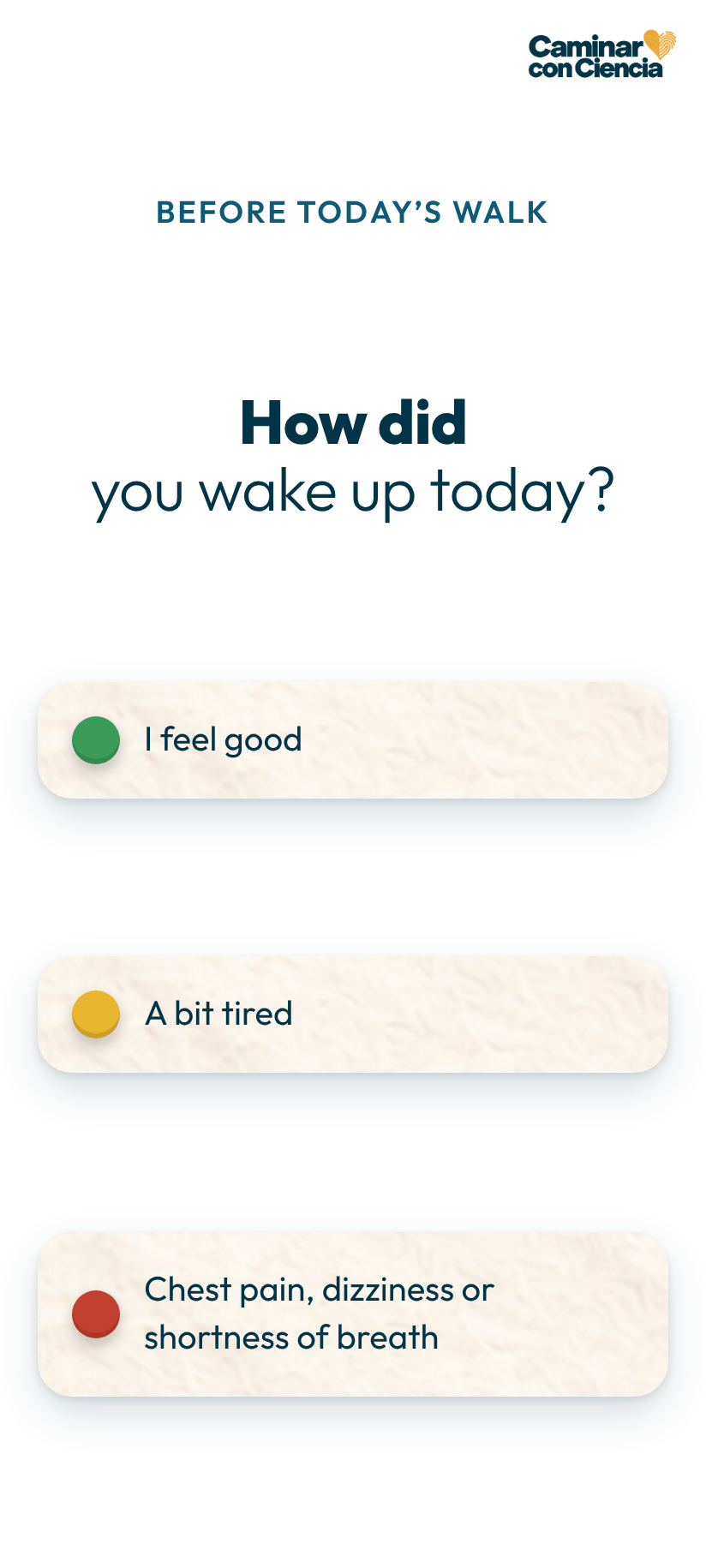
- “How did you wake up today?” check-in with warning signs
- Talk test and Borg scale during and after each walk
- Weekly load, same-effort progress and a doctor-ready PDF
Try both flows.
Tap the highlighted areas on the phone, or use the controls. Clinical notes appear next to the progress and doctor screens. All data shown is sample data.
The science behind each screen.
These clinical notes are not part of the app. Sources are linked below; some literal quotations are pending verification.
Why Borg and the talk test, not steps
Guidelines prescribe aerobic exercise by minutes, intensity and weekly frequency: at least 150–300 min/week of moderate or 75–150 min/week of vigorous activity (WHO 20203; U.S. HHS 20184; AHA5). The ESC 2020 guidelines frame prescription with FITT — frequency, intensity, time and type1.
The ESC notes intensity “is also commonly monitored using the rate of perceived exertion scale (e.g. 12–14 on the Borg 6–20 scale) or ‘talk test’, e.g. ‘to be able to talk while exercising’”1. The AHA describes moderate intensity the same way: you breathe harder “but you’ll still be able to talk”5. Borg’s scale6 and the talk test8,9 are validated, free and need no device.
In honesty about steps: step counts do carry evidence — a meta-analysis of 15 cohorts found lower all-cause mortality with more daily steps, leveling off around 6,000–8,000 steps/day in adults ≥60 and 8,000–10,000 in adults <6014. But a step count says nothing about intensity, hills or how the walk felt, so it cannot dose exercise. And the EAPC position statement warns that Borg and the talk test are an adjunct to an objective intensity method (such as an exercise test) in people with cardiovascular disease2. The app is for education and self-monitoring. Each person logs their own personal guidelines, agreed with their healthcare team. It does not replace medical evaluation.
Beta-blockers: why heart rate alone is not enough
Beta-blockers lower heart rate at rest and during exercise. The ESC states: “There are caveats to the use of HR for prescribing and evaluating exercise intensity in persons using beta-blockers. Ideally, the HR derived for training should only be used if functional capacity was determined (an exercise test was performed) while taking the medication”1.
In coronary patients on beta-blockers, a dedicated equation predicted maximal heart rate as 164 − 0.7 × age, with a standard error of 18 beats/min (r² = 0.13)11 — too imprecise for an individual target. The EAPC also notes that changes in beta-blocker dose complicate the target heart rate2. That is why the app’s core intensity signals are Borg and the talk test, and heart rate is optional.
Training heart rate (Karvonen)
When a user has a watch or strap and a target from their clinician, the app shows time in zone. The heart-rate-reserve method was described by Karvonen et al. (1957)10 and is cited by the ESC1:
The ESC adds that “the use of prediction equations for HRmax is not recommended” because of the large spread around the age line; a measured maximum from an exercise test is preferred1. Without a clinician-set target, the zone card stays hidden.
Hills and stairs: more effort at the same speed
The ACSM walking equation has a vertical (grade) term, so the oxygen cost rises with slope even when speed does not12:
S = speed in m/min · G = grade (decimal) · valid ~1.9–3.7 mph (≈ 50–100 m/min) · 1 MET = 3.5 mL·kg⁻¹·min⁻¹
Worked example (our calculation): at 3.4 km/h (56.7 m/min), level ground ≈ 2.6 METs; at a 5% grade ≈ 4.1 METs.
| Compendium code | Activity (as listed) | METs |
|---|---|---|
| 17170 | Walking, 2.5 mph (≈ 4 km/h), firm, level surface | 3.0 |
| 17034 | Climbing hills, no load, 1 to 5% grade, moderate-to-brisk pace | 5.3 |
| 17035 | Climbing hills, no load, 6 to 10% grade, moderate-to-brisk pace | 7.0 |
| 17133 | Stair climbing, slow pace | 4.5 |
| 17131 | Stair climbing, general | 6.8 |
| 17070 | Descending stairs | 3.5 |
Values copied from the 2024 Adult Compendium of Physical Activities (Herrmann, Willis, Ainsworth et al.)13.
The barometer: the phone’s barometer detects small pressure changes that track climbs and descents. Weather changes and phone position add drift, so the app reports elevation gain and the extra effort as estimates over a whole session, not step-by-step measurements.
The weekly dose: what the guidelines actually say
FITT. Exercise prescriptions are built from frequency, intensity, time and type, plus progression (ESC 20201; ACC 2026 scientific statement15).
How much. Adults should do at least 150 minutes a week of moderate-intensity aerobic activity, or 75 minutes of vigorous (WHO 20203; U.S. HHS 20184; AHA5), plus muscle-strengthening activities on 2 or more days a week (HHS 20184; AHA5). The ACC 2026 statement adds that resistance exercise should complement aerobic exercise for most adults15.
How hard. Borg 12–14 on the 6–20 scale (“somewhat hard”) is generally well tolerated in people with stable cardiovascular disease15. In plain words, HHS’s talk test: during moderate activity a person “can talk, but not sing”4.
The weekly total is what counts. HHS 2018 removed the old requirement of 10-minute bouts: “bouts of any length contribute to the health benefits associated with the accumulated volume of physical activity”4. The ACC 2026 statement notes that activity concentrated in 1 to 2 days is associated with similarly lower cardiovascular risk compared with more evenly distributed activity15. That is why the app tracks a weekly load.
From nothing to something. “Small increases in physical activity from none to some produce the largest reduction in death and CVD events”15; HHS likewise states that “a large benefit occurs when a person moves from being inactive to being insufficiently active”4. Even a first short walk counts.
Stairs and hills. They raise intensity without walking faster — see the ACSM grade term and Compendium values in “Hills and stairs” above12,13.
A wellness tool, not a diagnostic one. The app is for education and self-monitoring. Each person logs their own personal guidelines, agreed with their healthcare team. It does not replace medical evaluation. It does not diagnose or triage, and people who develop new symptoms during exercise should stop and seek medical attention, as the ACC statement advises15.
Session load and weekly load
Foster’s session-RPE method multiplies session duration by the rating of perceived exertion; it was validated against heart-rate-based training load7. Foster uses the CR-10 scale (0–10). Caminar con ciencia uses the Borg 6–20 scale throughout the app, so its load (minutes × Borg 6–20) is inspired by Foster but is not the original Foster load, and its numbers are not comparable with CR-10 values. Example: 30 min × Borg 13 (“somewhat hard”) = 390 units. Summed over 7 days it gives the weekly load and its trend — the “Your weekly workload” bars in the demo. Original validation was mostly in athletes and people without cardiovascular disease, so in people at cardiovascular risk it is used as guidance, not as a precise measure.
Clinical experience, published evidence.
The article
Sánchez Brzozowski E. “El rol del(la) fisioterapeuta cardiovascular: Estado del arte” (The role of the cardiovascular physical therapist: state of the art). Revista Médica Galeniux, 2026.
The guidelines
ESC 2020 sports cardiology1, ACC 2026 exercise prescription statement15, EAPC 2022 intensity statement2, ACSM metabolic equations12, WHO 20203 and U.S. HHS 20184.
The method
Prof. Ennio Sánchez Brzozowski, cardiovascular physical therapist and retired professor (Universidad Central de Venezuela), and his educational work.
The book
Caminar con ciencia — a guide to walking as a tool for cardiovascular health, beyond the 10,000-step myth. Coming soon.
Book link pending: not yet publishedReferences
- Pelliccia A, Sharma S, Gati S, et al. 2020 ESC Guidelines on sports cardiology and exercise in patients with cardiovascular disease. Eur Heart J. 2021;42(1):17-96. doi:10.1093/eurheartj/ehaa605
- Hansen D, Abreu A, Ambrosetti M, et al. Position statement on exercise intensity assessment and prescription, from the Secondary Prevention Section of the European Association of Preventive Cardiology (EAPC). Eur J Prev Cardiol. 2022;29(1):230-245. doi:10.1093/eurjpc/zwab007
- Bull FC, Al-Ansari SS, Biddle S, et al. World Health Organization 2020 guidelines on physical activity and sedentary behaviour. Br J Sports Med. 2020;54(24):1451-1462. doi:10.1136/bjsports-2020-102955
- Piercy KL, Troiano RP, Ballard RM, et al. The Physical Activity Guidelines for Americans. JAMA. 2018;320(19):2020-2028. doi:10.1001/jama.2018.14854 · HHS guidelines page · full text, 2nd ed. (PDF)
- American Heart Association. Recommendations for Physical Activity in Adults and Kids (last reviewed Jan 19, 2024). heart.org
- Borg GA. Psychophysical bases of perceived exertion. Med Sci Sports Exerc. 1982;14(5):377-381. PMID 7154893
- Foster C, Florhaug JA, Franklin J, et al. A new approach to monitoring exercise training. J Strength Cond Res. 2001;15(1):109-115. PMID 11708692
- Persinger R, Foster C, Gibson M, Fater DC, Porcari JP. Consistency of the talk test for exercise prescription. Med Sci Sports Exerc. 2004;36(9):1632-1636. PMID 15354048
- Foster C, Porcari JP, Anderson J, et al. The talk test as a marker of exercise training intensity. J Cardiopulm Rehabil Prev. 2008;28(1):24-30. doi:10.1097/01.HCR.0000311504.41775.78
- Karvonen MJ, Kentala E, Mustala O. The effects of training on heart rate; a longitudinal study. Ann Med Exp Biol Fenn. 1957;35(3):307-315. PMID 13470504
- Brawner CA, Ehrman JK, Schairer JR, Cao JJ, Keteyian SJ. Predicting maximum heart rate among patients with coronary heart disease receiving beta-adrenergic blockade therapy. Am Heart J. 2004;148(5):910-914. doi:10.1016/j.ahj.2004.04.035
- ACSM walking equation (ACSM’s Guidelines for Exercise Testing and Prescription, 10th ed., Table 6.3), as reproduced in: Metabolic Calculations in Action, Part 2. ACSM’s Health & Fitness Journal. 2020;24(4). journals.lww.com · Compendium: ACSM metabolic equations
- Herrmann SD, Willis EA, Ainsworth BE, et al. 2024 Adult Compendium of Physical Activities: a third update of the energy costs of human activities. J Sport Health Sci. 2024;13(1):6-12. doi:10.1016/j.jshs.2023.10.010 · Walking MET table
- Paluch AE, Bajpai S, Bassett DR, et al. Daily steps and all-cause mortality: a meta-analysis of 15 international cohorts. Lancet Public Health. 2022;7(3):e219-e228. doi:10.1016/S2468-2667(21)00302-9
- Myers J, Beckie TM, Chastin S, Fleg JL, Kitzman DW, Thompson PD, Wasfy MM. Exercise prescriptions for cardiovascular health in adults: 2026 ACC scientific statement: a report of the American College of Cardiology. J Am Coll Cardiol. 2026. doi:10.1016/j.jacc.2026.09.008

Walk with science.
Be the first to try Caminar con ciencia.
Thank you! You’re on the list (simulated).